











 Accessories and attachments
 Power tool parts
 Parts for combustion tools
 Power Tools
 Abrasives
Marka
Availability
Numer katalogowy oryginału
Typ
Jednostka miary
Rodzaj osi przedniej
Średnica pakietu
Price
Weight
Power tool parts Categories
Rotors
A wide range of rotors for power tools
Looking for a durable and reliable rotor for power tools? We offer a wide selection of replacements dedicated to the most popular brands, such as:
- BOSCH (e.g. GBH 2-24 DSR, GWS 850 CE),
- MAKITA (e.g. HP1640, GA5030),
- CELMA (e.g. PRCR 10/6, PRCB 10),
- HITACHI / HI-KOKI DH24PC3, DH26
- METABO,
- BLACK DECKER.
Perfect fit and quality
Our replacements are products that meet the highest quality standards:
- Precise fit - they perfectly fit a wide range of power tool models.
- Durable and robust performance - winding made of all-copper wire, flooded with resin for increased resistance.
- Components from the best sources - commutators come from reputable factories, which guarantees their reliability.
- Quality control - each batch of rotors is randomly tested at the factory for defects, correct voltages and other technical parameters.
- Attractive price - allowing you to save without sacrificing performance.
Restore full efficiency to your power tools with our proven solutions. Check our offer and find the right rotor for you!
How to choose the right rotor?
Each rotor in our offer has an original part number, which significantly facilitates its matching with branded power tools. In addition, each rotor is accompanied by exact dimensions, which allows precise identification for both branded tools and their Chinese or market counterparts.
In the case of Chinese and market tools, the dimensions of the rotor are crucial - compare them with the dimensions of the old part to ensure a perfect fit.
 Relevance
-
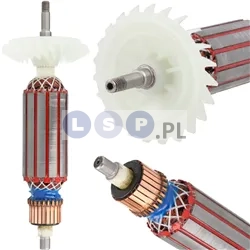
![Wirnik typ BOSCH GWS 9-115 GWS 9-125 GWS 880]()
-
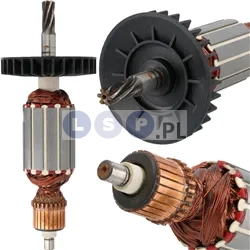
![Wirnik wiertarki MAKITA HR2460 HR2470 HR2470F]()
-
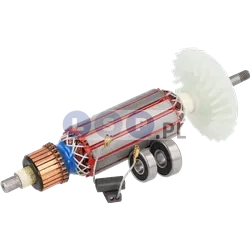
![WIRNIK DO SZLIFIERKI BOSCH GWS 9-115 GWS 9-125 S 1619P10952 ZESTAW]()
- Pack
Interesting facts about rotors - what is worth knowing?
What is an impeller and how does it work?
The rotor is the heart of any electric motor in power tools. Its task is to convert electrical energy into mechanical energy, which drives the tool. The main components of a rotor are:
- Windings - made of thin copper wire, through which electric current flows.
- Magnetic core - made of laminated steel sheets that minimize energy loss.
- Commutator - a cylindrical copper element that works with carbon brushes to transmit current to the windings.
The rotor rotates in the magnetic field generated by the stator, which generates torque. This allows the tool to drill, cut, grind or perform other tasks.
Why is the rotor so important?
- Key to performance: Without the rotor, the motor could not work and the tool would become useless.
- Work precision: The quality of the impeller affects the even operation of the tool and prevents excessive vibration.
- Tool durability: Regular maintenance and replacement of a defective rotor significantly extends the life of power tools.
How to recognize a defective rotor?
A malfunctioning rotor often manifests itself:
- Sparking around the carbon brushes.
- An unpleasant burning smell.
- Decrease in power or complete stoppage of the tool.
How is the rotor constructed?
The rotor consists of several key components:
- Rotor core - made of laminated steel sheets that are resistant to varying magnetic fields.
- Winding - usually made of copper, less often of aluminum, wound on the core.
- Rotor shaft - a central axis that transmits rotary motion to the tool.
- Commutator - a segmented ring that conducts current from the rotor windings to the brushes.
- Fan - built into some models to cool the rotor during operation.
The whole thing is precisely balanced to minimize vibration and ensure smooth operation of the tool.
How does the rotor function?
- Working with carbon brushes: The brushes transmit current to the commutator, which powers the rotor windings.
- Torque creation: Current flowing through the rotor windings in the stator's magnetic field generates electromagnetic forces that set the rotor in motion.
- Speed control: Rotor speed can be adjusted by electronic circuits, allowing the tool's power to be tailored to the task.
Rotor maintenance and repair
Regular rotor maintenance is the key to long-lasting, trouble-free operation of power tools. Here are some practical tips:
- Regular cleaning: Remove dust and debris from the rotor and carbon brushes.
- Brush inspection: Check the condition of carbon brushes - worn brushes can lead to sparking and damage to the commutator.
- Lubricants and bearings: Make sure rotor bearings are well lubricated and show no play.
- Replacing a damaged rotor: If the rotor is burned out, has visible damage to the windings or commutator, replace it.
Why is the rotor so important?
Without a functioning rotor, a power tool loses its functionality. Regular maintenance and replacement of worn parts, such as brushes or bearings, helps extend the life of both the rotor and the entire tool.
Interesting facts about rotors
- Rotors are precisely balanced to prevent vibration and excessive wear on the tool.
- In power tools of different horsepower and purpose, rotors can vary in size, material of construction and design.
- Their design must be able to withstand very high RPMs - even tens of thousands per minute for angle grinders!